Sunday, March 15, 2015

ALZHEIMER'S--SPRING TRAINING

Joe & Jane Spring Training 2015

This is the most perfect time of year to be in Arizona.  The desert has started to bloom, nights are warming up, sweaters are being stored, and best of all, it’s Spring Training.

If you’re a baseball fan you already know that every spring, just like the swallows returning to Capistrano, big league baseball teams return to sunny Arizona to tune and test their skills. 

They call it “The Cactus League”, and there’s a month long schedule of games which includes the Padres, Mariners, Royals and Rangers, to name a few.

This is our first Spring Training and Joe’s very excited about the opportunity to be up close to today’s baseball greats.  My dear niece and her guy are coming this weekend, and we’re all going to a game.

Since Al joined our household, I’ve learned the importance of planning for such events.   The more Joe understands about the details of what’s happening, the less stress and confusion we’re likely to experience.   

So last week, Joe and I drove out to the Surprise Campus to buy tickets, scout which gate we’ll use, and plan where to park.

As I mentioned, it’s a large complex that has several gates and parking lots.  Buying the tickets is the easy part, but figuring out the gate and parking is a whole other thing.

I quickly manage to get us in the wrong place, have to make several corrective moves, and wind up circling the park trying to get back to where we started.

Nowadays when we go out in the car, Joe’s role is to navigate.  He takes this very seriously and I’ve just totally confused him. His reaction is quite typical (no need to say more).  

He demands that I stop the car and let him out so that he can go ask someone who “knows what they are doing” (anyone other than me) how to get where we need to be. 

By now I am about to push Joe out of the car anyway, so I stop, put on the emergency flashers (I’m in traffic), and Joe gets out.  He walks over to a guy manning a gate entrance and after what seems like a long time, the two walk back to the car.  I’m still in traffic blocking a lane. 

The gate guy asks if I want to see the inside of the park.  Before I can answer, Joe tells me that I do.  So the gate guy gives me directions and I drive off to find the park lot, wondering how I get into situations like this in first place.

It turns out the gate guy is a very nice older gentleman.   He ushers us toward the stadium which, at this point, isn’t open to the public (it’s not a game day).

Joe and I walk through the gate and as we round a corner we see that we’re well above the field overlooking a beautiful, perfectly mowed playing surface. The entire stadium is pristinely polished and very quiet.  The only other people we see are a couple of employees busily unloading supplies.  

It’s like we have just entered a grand cathedral before a service; everything is perfectly prepared and waiting.  We stand there in awe and look out over the scene with a kind of reverence that makes you feel like you should whisper.

We eventually wander over to where we will be sitting, and agree that we have good seats (no stairs for Joe to climb and near to the restrooms).  It’s all good. 

By now, Joe’s mood is completely transformed from what it was before we walked into the stadium.  He shares some of his baseball knowledge with me as we slowly walk back out, neither of us really wanting to leave.
  
Back at the entrance, we stop to thank the friendly gate guy. I shake his hand and ask his name.  He smiles and says, “I’m Al.”

Joe and I turn to each other with big knowing smiles.  Al, (the gate guy) gives us each a souvenir pack of baseball cards (just like we were kids) and we say good bye.  We hold arms and try not to get killed jaywalking back to the car. 

It’s funny how things work out sometimes.  If I hadn’t been worried about going to the game and how Joe would deal with the hubbub, decided to drive out and scout the place, then gotten lost and frustrated, we wouldn’t have met Al (the gate guy), and had such a lovely and surreal experience inside the park.
Joe with the family (Kathleen and Cobey)

Now we both are looking forward to going to the game with our family and seeing the park transformed into its crowded, noisy, concession smelling greatness.

“Take me out to the ball game, take me out with the crowd.  Buy me some peanuts and……”

Monday, March 9, 2015

ALZHEIMER'S--I'D LIKE TO MAKE A DEPOSIT


THE MEMORY BANK


ACT 1, Scene 1

It’s an average sunny morning in Arizona.  Joe has just finished breakfast and is ready to start his day. He calls his trusted Memory Bank.  The conversation in his mind begins.

JOE.  I’d like to make a deposit into my memory bank.

THE CLERK.  (A pleasant voice.)  Certainly sir, please enter your password.

JOE. (Seems puzzled.)  I don’t know my password.

THE CLERK. (Still a very pleasant voice.)  I’m sorry sir, but without your password, we won’t be able to accept any memories today.

JOE.  (Stunned.)  I didn’t even know I had a password.

THE CLERK.  (Persistent tone.)  Yes Sir, you have a password.  Let me see here.  (Joe hears typing.)  Here it is.  It was added about a year and a half ago, someone by the name of “Al Heimer”.  

JOE.  (Sound effects from “Law and Order” play in his mind.  He starts getting agitated.)  Alright then, let me just withdraw a few memories for today.

THE CLERK. (Speaks louder.)  Sir, as I told you, without a password we won’t be able to accommodate you.

JOE.  (Now quite agitated.)  For crying out loud, who do I need to talk to around here to get a few memories?

THE CLERK. (Condescendingly.) I would suggest that you call your neurologist.

THE NARRATOR. (Soft music plays in the background.)
“Memory banks”, that’s what we call them because they are so valuable.  They’re what defines us as an individual, serving as a road map as we maneuver through our lives. 

Some memories are simple and require little thought.  Some are so important that we back them up by writing them down.  And others may be so terrible we try hard to forget them.

Each day we make deposits and withdrawals through our memory banks.  It’s an automatic process, no passwords or authorizations, we own them; they’re ours to manage, unless you’re living with Al.

Memories are becoming an everyday struggle for Joe because Al has added a password to Joe’s Memory Bank and keeps changing it.  (This is, of course, a metaphor for how it feels to Joe.)

ACT 1, Scene 2

Later that same day.  Things haven’t been going well for Joe.  His memory bank is still locked up.  (The quiet is shattered by the same male voice.)

JOE.   (Search for the lost item.) I know I had it this morning.  It was right by my chair.

JANE. (Trying to be supportive.)  Well, did you look in the bathroom?
 
JOE. (Annoyed.)  Why would it be in the bathroom?  I always put it next to my chair.

JANE. (Frustrated)  Well, why don’t you look anyway?

JOE. (Shaking his head.)  Okay, but I know it isn’t there. (He leaves and returns again without it.)  I told you it wasn’t there.  (Exasperated, he circles the house searching.)  It’s been stolen. 

JANE. (Working in the kitchen, opens the refrigerator and see’s it on the top shelf.)  Well now, I think I see where the thieves have hidden it.

JOE. (Moves hastily into the kitchen and looks into the open refrigerator.)  Why in the world would they hide my remote control in the refrigerator? 

JANE: (Big sigh.) Maybe they’re Television Critics.

The End (Curtain)


Well, maybe not the end.  I have a feeling there will be a sequel.
The Star of the Show


Tuesday, March 3, 2015

ALZHEIMER'S--LET'S GET THEATRICAL


Joe, the early bird, waiting for the play to start 2012

“Just give me the first word, that’ll get me started.”

Every time I auditioned for a play it was the same thing, a little panic and lots of worry that I just might have bitten off more than I could chew.  Maybe this time I wouldn’t be able to memorize the umpteen lines of the character I wanted to play.

What if I got on stage and blanked?  It happens, not just to community theater actors, but to professionals on Broadway, too. 

It is the most terrifying experience to believe that you are “well-rehearsed”, that you have it down pat, only to step on stage, open your mouth, and have no words come out.  It is to be avoided at all cost.

Joe knew how much I loved theater and performing, and he was always more than willing to help me prepare for a part.  We would spend hours running lines. 

I would set a daily goal, maybe three pages.  That doesn’t seem like many, does it? 

For me to memorize three pages a day required intense concentration and a lot of backing up and doing it over.  Joe would sometimes get annoyed with me after I screwed a line for what seemed like the hundredth time, but we persevered and eventually I would get them.

By opening night of the play, I would be as ready as I possibly could be, and so would Joe.  Not only had he coached me to remember every line, but in the process he could say virtually every line himself.  I used to say that if I fainted and fell off the stage he might have been able to go on as my understudy.  (Well, that might have been a bit far-fetched.)

He sat through many performances of a play, and no one was happier than Joe when I would make it through the final act without a major blow up.   He was an excellent partner in the process.

Many times I tried to get Joe to join our theater group, to become openly involved.  He always declined.  Back then I didn’t understand why, but I now believe it was Al. 

I’m sure that Joe felt the changes that had begun.  He knew something wasn’t exactly right with his ability to socialize, hang out with a group, and mingle; the way he dealt with his discomfort was to withdraw from anything that would reveal a problem.

Joe started a slow social shut down.  Watching sports was in his comfort zone, so that’s what he did.  After all, he had always loved sports and watching it didn’t require any social interaction. 

He still played golf, but it was with people that he knew very well, that wouldn’t tax him socially, letting him focus on golf and the competition.

I wish I could go back to some of those experiences with Joe.  I think I would be more sympathetic and understanding of his withdrawal. 

I’d get upset with his refusals to come out of the cave (the den).   Back then, I’d have been happy if he had shown interest in anything that would have gotten him out into the world (poker, ballroom dancing, bodybuilding, falconry). 

There were many nights that I left Joe “home alone” to fend for himself, dinner in the fridge.  

Joe didn’t complain about any of that, but in retrospect I understand that being alone wasn’t what he needed.  Now that we’re more familiar with Al, we know the importance of social interaction, exercise and healthy eating, and that each are of equal weight in dealing with this beast.

It’s still a challenge to get Joe going and out of the house.  I have to be creative sometimes, or just plain pester him until he gives up.  There are days he really would rather sit in his chair and view a high definition world through a 50 inch screen.

Me getting theatrical
It’s probably time I thanked Joe for the support he provides to all of my endeavors.  For 35 years, he’s put up with my creative digressions, all of my nonsense, every wacky design idea.  The guy has been through a lot with me and my menagerie.

That’s why it’s not hard to put the brakes on my other interests and focus on Joe.  When he needs a little help figuring things out, I’m there to point the way.  If he needs support to keep Al at arm’s length or duct taped to a lawn chair, it is my pleasure to assist. 

I’m there when he says, “Just give me the first word, that’ll get me started.” (Déjà vu.)

In a play when there is a radical change in its expected direction, it’s called a “plot twist”.   Life is full of “plot twists”.
Bravo, Joe!


Wednesday, February 25, 2015

ALZHEIMER'S--AND THE OSCAR GOES TO

Oscar night 2015

It was a tough week with all the preparation for the Oscars.

There were the interviews, the hair and makeup, sessions with the stylists, the fashion designers, the pre-parties; and don’t even mention the selection of jewels and shoes.  I’m exhausted.  I may sleep for a week.

I watched it all and on Oscar Night, I sat in suspense breathlessly waiting for the winners to be announced.  Would it be Michael Keaton, or that freckle-faced kid, Eddie Redmayne?

I hadn’t seen a single one of the films nominated but I was there, supporting them all, every word, watching all the clips and pleading for those most deserving.

I wasn’t there alone. Joe and Al and my sister-in-law were there sweating it out with me.  We couldn’t believe it when Neil Patrick Harris showed up in his briefs. It was the biggest wardrobe malfunction since the historic Jackson/Timberlake event in 2004 and it was right in our living room, in high definition and surround sound.

It was a perfect night.  Well, almost perfect.

Things started to change for me when they got around to Tim McGraw. 

The lights came up as Tim sat alone on the stage.  The music started, and before I could take cover, he began to sing.  There was no escaping. It was too late, and I had to listen.  I knew what was coming. 

I’d heard it before. “I’m Not Going to Miss You”, the haunting lyrics of the last song recorded by Glen Campbell (diagnosed with Alzheimer’s in 2011).  

Not to take anything away from McGraw, but the words of that song stand alone, sung or spoken.  Just like the first time I heard them, they burned through me like fire, scorched my heart, and I cried. 

That song is much more to me than a love song or a country boy sad song.  It overwhelms me; the idea that someone you love and has been with you for most of your life, may someday simply not remember you.  How could that be?  What an absolutely and totally cruel joke to play on life. (Long pause.)

Okay, that’s enough.  We must move on because the night wasn’t over and it was time for dessert (chocolate Oscar cake). 

I’m always impressed with the lack of preparation on the part of most Oscar winners.  Wouldn’t you think that they would have a completely rehearsed acceptance?  Many started with, “I don’t know what to say.”  Really?

For me, the night was capped when Julianne Moore won the Oscar for her leading role in the film, “Still Alice”.  Of course, that’s because our family is one of the 5 million in the US dealing with “Al”, the Uninvited Guest.

This morning I logged on to my Twitter account and checked in with the Alzheimer’s community.  The website was abuzz with energy surrounding Moore’s win. 

The general consensus today was that Alzheimer’s awareness may have just gotten a very much needed shot in the arm.  You couldn’t ask for better publicity than a Golden Globe and an Oscar win. 

I read recently that Alzheimer’s kills more Americans than prostate and breast cancer combined.  By the time a woman is in her 60’s, her estimated lifetime risk for developing Alzheimer’s is 1 in 6.  For breast cancer it is 1 in 11.

Any way you measure it, Alzheimer’s stinks.

Once again the Baby Boom generation (my generation) will make their mark on the nation.  By 2045 the number of people age 65 and older with Al may triple, from 5 million to 16 million.  That’s roughly the population of one of the largest cites in the world, Shanghai, China. 

Of course that assumes no breakthroughs to prevent or stop this beast.  For all of our sake let’s hope there is a breakthrough.

A little kiss for Joe

It looks like Joe and Al and I will be staying home over the next several weeks.  We have a rather large queue of movies to get through.  After all, one must stay current. (I’m still trying to get through the 2014 winners.)  Does anybody have “The Grand Budapest Hotel” on Blu-ray?

Saturday, February 21, 2015

ALZHEIMER'S--I SEEM TO HAVE MISPLACED MY SENSE OF HUMOR

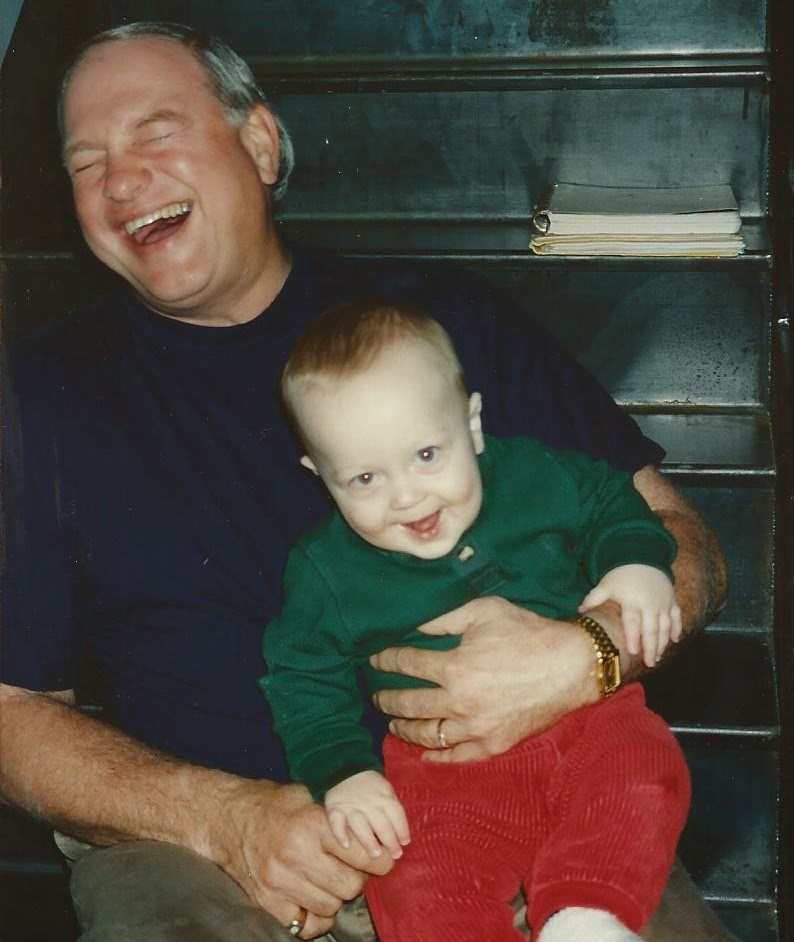
Joe and grandson Calvin having a big laugh 1994


Have you ever heard something that you thought was humorous and then tried to explain to someone else why it was funny? Sure you have, and I’ll bet it was difficult. 

How do you explain humor? Or better yet, how do you explain sarcastic humor? 

There are so many elements involved in humor that for me, it would be like trying to explain nuclear fission, an inexplicable mystery. 

With thousands of years of speculation, there’s still no real agreement on the purpose of humor. I say, “Who cares”?  I know what it does for me. It makes me feel good and it makes me happy.  

One of my greatest treasures as a mother and grandmother has been that first time one of the children laughed at something they found funny. It was confirmation that they truly were developing a sense of humor, a personality; one they would carry with them throughout their life. 

I had no idea that a person could lose their sense of humor, I mean really lose it, simply not have it anymore. Well, that was before Al, the Grinch, parked his sled in our yard.

There are a few situation comedies that we frequently watch on TV and lately I’ve noticed Joe’s not laughing.  Not that the programs are so excellent, but we could always find things that made us laugh. (How could you not laugh during an episode of “The Big Bang Theory”?)

I thought it was just the same hearing issue. So, I started repeating the punchlines. It didn’t help. Even with the TV cranked up a few decibels, still not much.

Now, I don’t give up easily, so I started rephrasing the lines for him with extended explanation. Oh boy, that doesn’t help at all.

I’ve known people that I would call very literal, meaning they took words in their most basic, exact sense and didn’t leave room for humor.  But this was different. Joe wasn’t like that.

He’d never been one to tell jokes, but he would be the first to react. He had a BIG laugh, one that filled the room. He liked my attempts at humor and called them “Jane Jokes” (meaning mostly corny). 

I’m not saying that Joe has lost all of his sense of humor, it’s just different than before Al. It’s slower, less spontaneous, and requires a little coaxing (we’re still talking about humor here). 

I’ve taken on the challenge to help Joe laugh every day, at least once, if not for him, for me.  Some days it’s more of a challenge than others to pull him away from Al, out of the grumpy zone, and get a good laugh going.

Today was a routine visit to Joe’s neurologist (of course Al tagged along). There was no news, good or bad. We just shook hands, shared a few smiles, listened to the “no news”, and were out the door.
 
On the way home we talked about Joe’s appointment and what it must take for a doctor who is trained to “heal” to go through that process day after day, saying the same things to different faces, each patient sitting there with their own “Al”.  

Wow, if anyone could use a good laugh it probably would be Joe’s doctor.

It may seem trivial to talk about laughing with so many other “Al” issues on the road ahead of us. I understand that there are many pieces of Joe that I may lose. But, laughter and humor are right up there on the top of my list of things I will fight for. And that’s no joke.

At the risk of being politically insensitive, we’re hoping to laugh all the way to the funny farm.

Valentine’s Day was last weekend.  We should have booked a flight from sunny Arizona to frigid Northern Alaska so Joe and Al could go ice fishing.  Did you catch that?  Now that was “sarcastic humor”.

Sunday, February 15, 2015

ALZHEIMER'S--THE DEAR "AL" LETTER

Joe and grandchildren 2004

By age five you probably had it down: 
Don’t talk too loud. 
Say please and thank you. 
Keep your hands to yourself.
Wait your turn. 
Don’t talk to strangers. 
Flush.
Tell the truth. 

These are some of the social rules that kept you out of trouble.  But, if you’re undergoing cognitive changes (living with Al), the simple social rules you’ve applied your whole life can suddenly start to unravel. 

Joe and I are shopping.  It is just before Christmas so the lines at the checkout are longer than usual.  We’re stuck behind several other customers so Joe (and Al) decides to move out of line to sit on a stack of toaster ovens. 

Joe’s right on an intersection of aisles, and is watching shoppers pass.  He sees a mother with two toddlers and a baby coming down the aisle.  (Joe just loves babies.)   As the little family walks past Joe, he stands up and reaches out for the baby.   The mother stops in her tracks, looks startled, then pulls her baby slightly out of Joe’s reach.

Joe hasn’t noticed any of this, and begins to speak to the baby, “Hi there little guy.”  The mother continues to look at Joe.  It takes her a moment to finally decide that Joe isn’t menacing or threatening.  She pauses as long as she can without seeming rude, and then hurries off with her chicks.

I finish up my purchase and join Joe.  “You can’t touch other people’s children,” I tell him, “they don’t know you.” 

Joe looks puzzled. “I was just saying hello. Did you see how cute that little one was?”

At this moment, Joe has no idea that the mother didn’t want him touching her baby.   I try to explain why, but the notion that she might feel threatened just doesn’t make sense to him.

Awhile back, we’re at a restaurant when Joe and Al march to the front of the line and demand to be seated.  Joe has waited long enough.  It doesn’t matter that we’re still four couples down on the waiting list, he’s hungry.

A similar event takes place at his doctor’s office.  We’re waiting in an examination room when the doctor arrives a few minutes beyond our appointment time, the first thing Joe says is, “YOU’RE LATE!”  

I know there’s some term for what’s going on in Joe’s mind.  I’ve read the descriptions of what happens to your “executive function” (kind of the “CEO” of the brain) when you’re dealing with Al, Mr. Faux pas.   But it’s tough to see Joe struggle with awkward situations that in the past he would never have created in the first place.

Joe was plugged-in to social protocols.  He made a living talking to people, selling the tangible and intangible.  He could size up a social situation just by looking around the room. He analyzed the bejesus out of everything. 

It’s frustrating not knowing exactly how to help Joe.  It’s easy to manage the physical things for him like cooking, doling out medications, and driving place to place.  But it’s much harder to deal the social issues.  How do you tell your husband that he’s just offended someone with an ill-advised comment or action, and not seem overbearing?  There’s a fine line between being tactfully helpful and being bossy.  (Joe would say I frequently pole vault over that line.)

Well, I’ll keep working on it.  Somewhere there‘s a balance to be struck.

I’ve been told that writing letters can sometimes be cathartic (to help sort out your feelings and emotions).  I think I’ll try it.

This is my angry “break up” letter to Al.  (The director in me says to read this in a sarcastic Christopher Walken dialect.)

Dear Al,
I assume you were satisfied with your time with us in the Northwest, and that you’ve been enjoying the sunny weather here in Arizona.  However, there are a few things I wish to get off my chest.

First, just who do you think you are, sneaking into our lives and messing up all of our years of planning and preparation for our future?  Do you not understand how you are affecting the lives of our children and grandchildren?

Second, I suppose by now you’ve noticed the pain, frustration and disruption you’ve caused Joe, not to mention the scissors you’ve taken to his short term memory.  

Lastly, you are cruel and heartless, and lack all conscience.  It is without regret that I inform you that we are dumping you.

There is an army coming for you (our posse is armed and dangerous), and we’re going to fight you with our time and our money.

Sooner or later, Al, you will be kaput, a goner, finished, and we will all square dance at your demise.
Sincerely,
Jane Gayer

There, I do feel better.


***Join the posse and help us beat Alzheimer’s.  Logon at:
http://www.alz.org

Sunday, February 8, 2015

ALZHEIMER'S--PITCH ONE TO ME

Joe and Grandson Joey at the Tournament 2014


Just after Joe and I started dating, so about a million years ago, we attended our company picnic together.  (Yes, we were an office romance.) 

Joe in 1956
By then, we had shared a few stories from the past so I knew that Joe had been an athlete.  He’d told me about growing up in the Midwest in the 40’s and 50’s, and how he’d spend most of those summers on a ball field.

He explained that his first “real” job, after being discharged from the Army, was with a large company that also had a softball team that competed in a five state regional league.

Joe was proud of the fact that he got paid to be a company employee, but what he really did was play fastpitch softball for them.  In fact, he’d helped the team go all the way to the World Series of Fastpitch.

So on that day at the picnic, as Joe participated in our company’s softball game, I shouldn’t have been surprised to see him round third base and slide into home plate. 

In the process, he shredded a brand new pair of white shorts and got a huge raspberry on one hip.  When I asked him “why” he slid into home, he simply said, “I could have been out.”

That was the first time I understood just how competitive Joe was, and how important sports were to him.

Fast forward to this year—we’re now living in an “Over 55” community  and apparently, there are many other senior guys with Joe’s same love for a ball field because they have created a “very senior” and “very” slow pitch softball league.  (It’s quite the big deal, with a nice field, electronic scoreboard, uniforms, and a schedule printed in the newspaper, the whole megillah.)

Last week, Joe and Al and I went to one of their games.   We sat in the stands and ate popcorn just like at Wrigley Field in Chicago.

As I mentioned, this is a very senior league.  The average age within the community is somewhere around 74.5, and there are guys with all types of physical challenges.  They even have pinch-runners if you can’t make it around the bases.

I sat there and thought Al (this lousy disease) is the only reason that Joe can’t just sign up for a team, and get out there and do something he would totally enjoy.  It’s all Al, nothing else.  I suddenly wished I could push Al off the stands.

Without this disease that is robbing Joe of his mental and emotional flexibility he could take a pitch, run the bases, and field a ball with the best of them.  There would be no stopping him. 

It frustrates me to think about how many things Joe has had to give up.

But then I remember how much Joe enjoyed watching his grandson, Joey, play baseball.  During a trip to Las Vegas this fall, Joe was so proud of Joey when his team won the whole tournament.

Joe got so excited that at one point during the final day of the tournament, our daughter had to remind him that if he didn’t stop chiding the ump, he might be thrown out of the park.  And, there were those little conversations Joe had with the team manager in between games where Joe imparted his vast wisdom. (I’m not sure I want to know exactly what Joe and Al said to the manager.)   It was pure delight for Joe to be there.

I guess that’s what happens in life.  Sooner or later you have to come off the field and sit in the stands and cheer for the generations that come after you.  (I usually don’t like sports analogies, but this one “hit it out of the park”.)

We try not to grieve over the things that are lost, but enjoy what we still have while we still have it.  After all, as long as you can remember even some of what you once did, you can still brag.

Tomorrow is Friday, “TGIF” or “GIFT” if you are dyslexic like me.


By the way, our daughter just called to announce that grandson, Joey, who is still a high school junior, just made his “varsity” baseball team.  Way to go Joey!!  There's that bragging thing.